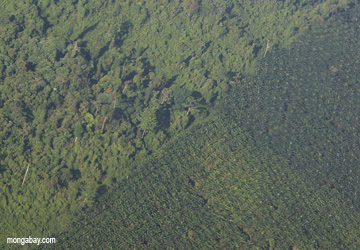
Article on Biodiversity & Human Well-Being in Climate Forest Governance


Biolaw readers may be interested in the article Global Climate Governance to Enhance Biodiversity & Well-Being: Integrating Non-StateNetworks and Public International Law in Tropical Forests (forthcoming in 41 Environmental Law, 2011), which is available for free download here.

Here is the abstract:


Environmental governance frequently represents a leading edge of global regulation. The climate regime even continues to create new modes of regulation despite a negotiation impasse. These new initiatives, like existing legal approaches to environmental challenges, too often embrace a fragmented view of issue areas that fails to reflect fundamental connections between the objects of regulation. The shortcomings of a state-driven international issue-by-issue approach to global environmental governance have long been obvious in some areas (such as tropical forests), and are becoming ever clearer in others (most notably climate change). Therefore, private networks play an increasingly important role in global environmental governance, as illustrated most directly by forest certification that was developed to fill a gap left by negotiation failures of the 1990s. These prior failures also laid the groundwork for tropical forests to become an object of climate regime regulation, giving rise to one of the most promising and innovative programs for generating a much-needed new approach to global environmental governance more broadly. The reduced emissions from deforestation and degradation (REDD) program holds out the promise of not only reducing greenhouse gas emissions in the forest sector, but also promoting public goods associated with biodiversity and human well-being. Nonetheless, REDD remains incompletely formed and fragile. An over-emphasis on mitigation, which seems likely given REDD’s climate regime origins, may prove self-limiting or even self-defeating for the program. In response to this concern, and the need for greater recognition of issue-linkages in designing global environmental regulation generally, this article proposes a novel hybrid public-private governance approach to REDD that can encourage maximum emissions reductions while also effectively promoting a broad array of benefits for biodiversity and human well-being. In so doing, the article also offers an innovative and generalizable model for combining private market finance and public funding to increase the coherence and effectiveness of global environmental regulation.

Psychological Interventions For Post Disaster Trauma


The world sighed a collective breath of relief when all 33 of the miners trapped in a Chilean mine for over two months were rescued this week. But the health risks for some of these minors may not be over. As I blogged previously here in the context of the serious emotional distress suffered by children affected by Hurricane Katrina, those who survive disasters are at significant risk of psychological problems such as post-traumatic-stress-disorder (PTSD), depression, anxiety and substance abuse.

It is imperative for those in the public health community to recognize that this risk can vary among individuals and that currently popular interventions may be ineffective and, more importantly, can actually cause harm in some cases. In a press release this week, The Association for Psychological Science cautions that post disaster interventions that attempt to deal with emotional distress should carefully focus on techniques with strong scientific evidence of effectiveness.

In an upcoming report on the psychological effects of disasters in Psychological Science in the Public Interest, a journal of the Association for Psychological Science, George A. Bonanno and colleagues note that
… '[f]ollowing disasters, the most common form of immediate psychological intervention is a single session known as critical incident stress debriefing (CISD). However, following a review of studies on the effectiveness of CISD, Bonanno and co-authors conclude that “multiple studies have shown that CISD is not only ineffective but, as suggested earlier, in some cases can actually be psychologically harmful.'

In a 2007 report in Perspectives on Psychological Science, a journal of the Association for Psychological Science, Scott O. Lilienfeld shows that a number of psychological therapies, including CISD, especially if forced upon survivors, may actually be harmful.

'The data on crisis debriefing suggest that imposing such interventions on individuals doesn’t work and may, paradoxically, increase risk for PTSD,' Lilienfeld says. 'If any of the miners want to talk to somebody to express their feelings, then by all means mental health professionals should be there to listen to them and support them. But for miners who would prefer not to talk much about the experience, it’s best to leave them alone and respect their own coping mechanisms.'

According to Bonanno and his co-authors, there are therapies that may be effective in helping survivors recover from disasters. Psychological first aid (PFA)—which, among other things, provides practical assistance and helps promote a sense of safety and calmness among survivors—is a promising approach. In addition, community-centered interventions—those that help maintain a sense of continuity, connectedness, and quality of community life—may be beneficial to survivors of disasters.

The Use of Best Management Practices to Reduce Nutrient Pollution in the Everglades Agricultural Area

It is only after my recent move to South Florida where I routinely drive on the Sawgrass Expressway that I appreciate how the wild beauty of the South Florida Everglades lives cheek to jowl with the buzz and press of busy city life.


William H. Owen captures this juxtaposition in a recent Earth Magazine article:
As the sun rises over the vast Florida Everglades, the endangered Florida panther quietly stalks a white-tailed deer in the tall grass. A raccoon fishes for its breakfast of crayfish. A small flock of rose-colored waterfowl flies overhead, a reminder of the vast flocks of wading birds that once called the Everglades home. A couple of otters roll around in the water nearby, keeping a watchful eye out for ubiquitous alligators. Manatees swim silently below the surface in Florida Bay, at the southern end of the Everglades ecosystem. Suddenly, a tractor engine revs to life as a farmer prepares to harvest his sugarcane, and the noise of commuters driving to work on the Sawgrass Expressway disturbs the calm. Such is life in the Everglades, where modern civilization meets wild in a vast subtropical wetland.

The Everglades is the largest subtropical wetland in the United States. It is an internationally recognized ecosystem that covers approximately two million acres in South Florida. Urban and agricultural development has endangered the biotic integrity of this ecosystem. One example of this development is the Everglades Agricultural Area (EAA). The EAA is one of several large portions of the original Everglades that was drained for commercial, agricultural and residential development. The EAA is approximately 700,000 acres and is 27% of the original Everglades. Drainage waters from the agricultural lands in the EAA contain nutrients, primarily phosphorous, from the use of fertilizers, herbicides and pesticides. This agricultural runoff flows downstream to areas that include the Everglades National Park. These excess nutrients have allowed nutrient loving plants like cattails to overrun the wetlands, displacing native species such as sawgrass.

In an article titled Reducing Nutrient Pollution in the Everglades Agricultural Area through Best Management Practices, Professor Alfred R. Light chronicles the social, legal and regulatory history of nutrient pollution reduction efforts in the EAA. Professor Light explains how the EAA farmers have recently used Best Management Practices to take the irrigation water with high phosphorous levels that flows into their fields and reduce those levels before allowing the runoff to drain downstream. Professor Light suggests that the successful use of Best Management Practices by EAA farmers will be a bellwether for other US farmers facing similar nutrient pollution problems. The abstract of the Article reads:
Some Florida farmers recently have been reducing the level of nutrient pollution discharged from their fields and entering sensitive Florida ecosystems from the level found in the irrigation water they use. They are doing this while continuing to operate their productive farms. Setting a water quality standard seems to have driven actual “real world” improvements in water quality in Florida, including development of the data and research needed to support those improvements. Mandatory BMPs seem to have worked in reducing phosphorus concentrations in water leaving the EAA. In fact, phosphorus concentrations in water leaving the EAA are about half of the concentrations in irrigation water entering the region. Other regions of the country with significant nutrient pollution thus may be looking to Florida to find out how farmers can be part of the solution rather than part of the problem. Florida’s BMP program in the EAA thus may be a bellwether for other states seeking to confront the challenges of nutrient pollution.